Comprehension of Data Visualisation

By Kasia Kruk

A radical social transition needs to take place to prevent the climate change from progressing as rapidly as it is now. In order to achieve that, we need good communication tools, which could spread the environmental awareness and improve the understanding of the current climate action urgency.

Over the past few months that was the focal point of this climate data visualisation project – how can we raise the awareness of the climate action’s urgency?

Continue reading “Comprehension of Data Visualisation”

Science as a gift economy

This post is inspired by my brother Max Urai, the better writer of the family – two steps ahead in his thinking, as always. Why literature is a gift-economy (Rekto:Verso, in Dutch). I shamelessly copied some quotations.

The pursuit of scientific knowledge works by virtue of the work of others. We stand on the shoulders of giants, re-mix and improve, discuss and critique; and we hope to leave our communities a bit better than we found them.

Such intellectual exchange can be characterised as a gift economy. This system operates very differently than the familiar market economy, where a trade of specified value is made, and both parties then go their own way. In the gift economy, on the other hand, our gifts cannot be precisely quantified. Rather, receiving gifts ties us the broader community, and commits us to return a gift – at some point, in some form, to someone (but never exactly).

Reciprocity in life and in the academy is a feature of infinite play. Reciprocity colonizes your future by enrolling you in longitudinal practices of giving and getting. When your child finishes college, you do not present them with a bill for all of the expenses they cost you growing up. If you do, you are planning to never see them again.

Bruce R. Caron, 2021
Continue reading “Science as a gift economy”
Preprint review: behavioural state shifts are predicted by fluctuations in arousal

By Philippa Johnson

Review of: Daniel Hulsey, Kevin Zumwalt, Luca Mazzucato, David A. McCormick, Santiago Jaramillo. Decision-making dynamics are predicted by arousal and uninstructed movements. bioRxiv, doi: https://doi.org/10.1101/2023.03.02.530651

In a recent lab meeting, we discussed a preprint by Hulsey et al. (2023), which investigates whether fluctuations in arousal can account for some of the variability found in decision-making behaviour. In psychology experiments, we usually implicitly assume that people/animals perform the same cognitive task with the same strategy during an experimental ‘session’ – but more and more research shows that this is a bit naïve, and that we can draw false conclusions if we don’t take these nonstationarities into account. After all, the way we process information at the beginning of a boring lecture is surely very different to how we process information towards the end!

Continue reading “Preprint review: behavioural state shifts are predicted by fluctuations in arousal”

Doughnut science: rethinking academia in a time of climate crisis

How to be an academic in a world on fire?

As scientists concerned about the climate crisis, we set out to rethink the role and goals of the university in tackling the 21st century’s challenges. Inspired by Raworth’s Doughnut Economics, we propose seven new ways to thinking – not only to help us think, but also to act.

Read the paper: Urai AE, Kelly C (2023) Rethinking academia in a time of climate crisis. eLife 12:e84991. https://doi.org/10.7554/eLife.84991
Join us for a discussion at Growing Up in Science Global on 11 April: https://nyu.zoom.us/meeting/register/tJIoc-GsqT8uGNXniBIHPo9u4ibfDwxysLkI

… and let us know your thoughts!

Update: our article has been translated into Spanish [link here].

How to make big decisions

This week, a good friend (let’s call them W.) was facing a big decision: they got a job offer but were unsure whether to accept as it would come with some major life changes. W’s hesitation, doubt and slight panic reminded me of myself just 2 years ago. This quick blog describes some techniques for decision-making that can help in cases where uncertainty is rife and stakes are high.

Continue reading “How to make big decisions”

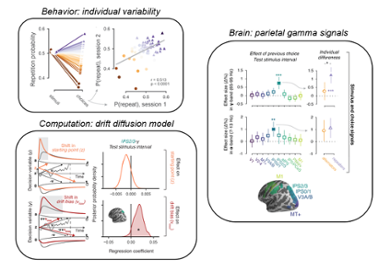
Individual choice repetition biases arise from persistent dynamics in parietal cortex

Across many decision-making tasks, people and animals systematically repeat (or alternate) their choices – even when the choices they make are intrinsically uncorrelated. This phenomenon (also known as ‘sequential effect’ or ‘choice hysteresis’) has been known for at least a century, and may be a stable individual trait. How do these behavioral biases arise from the activity of the brain?

Continue reading “Individual choice repetition biases arise from persistent dynamics in parietal cortex”

DNM Young Talent Award

I am proud and honoured to have received the Young talent award from the DNM Dutch Neuroscience society. This was the first time I explicitly talked about my climate activism in combination with my neuroscientific pursuits, which I hope contributes to more conversations about the climate crisis within the Dutch neuroscience community.

Continue reading “DNM Young Talent Award”