By Eleanor Holton and Anne Urai
Do neuroscientists want to talk about climate change? Turns out they do, if we are to take anything from the CCN climate workshop which took place in Oxford a couple weeks ago. While a two-hour workshop after a days worth of packed neuroscience talks may not seem like a big draw, the event was packed.
The workshop began with a talk from Clare Kelly, on the role that academics can play in tackling the climate crisis. Drawing inspiration from Kate Raworth’s theory of doughnut economics, Clare and Anne have written an article which applies the revised ‘doughnut’ model of economics to academia. Raworth’s idea (in short) is that traditional economic models assuming growth maximisation will (and already have) led to catastrophic over-stepping of planetary boundaries. Rather than maximising growth, Raworth argues the model must be revised: the aim should be to balance planetary boundaries (the ‘outside’ boundaries of the doughnut; e.g. biodiversity loss and climate change) with the minimum social standards needed for healthy society (the ‘inside’ boundaries of the doughnut; e.g. food, health, and education).

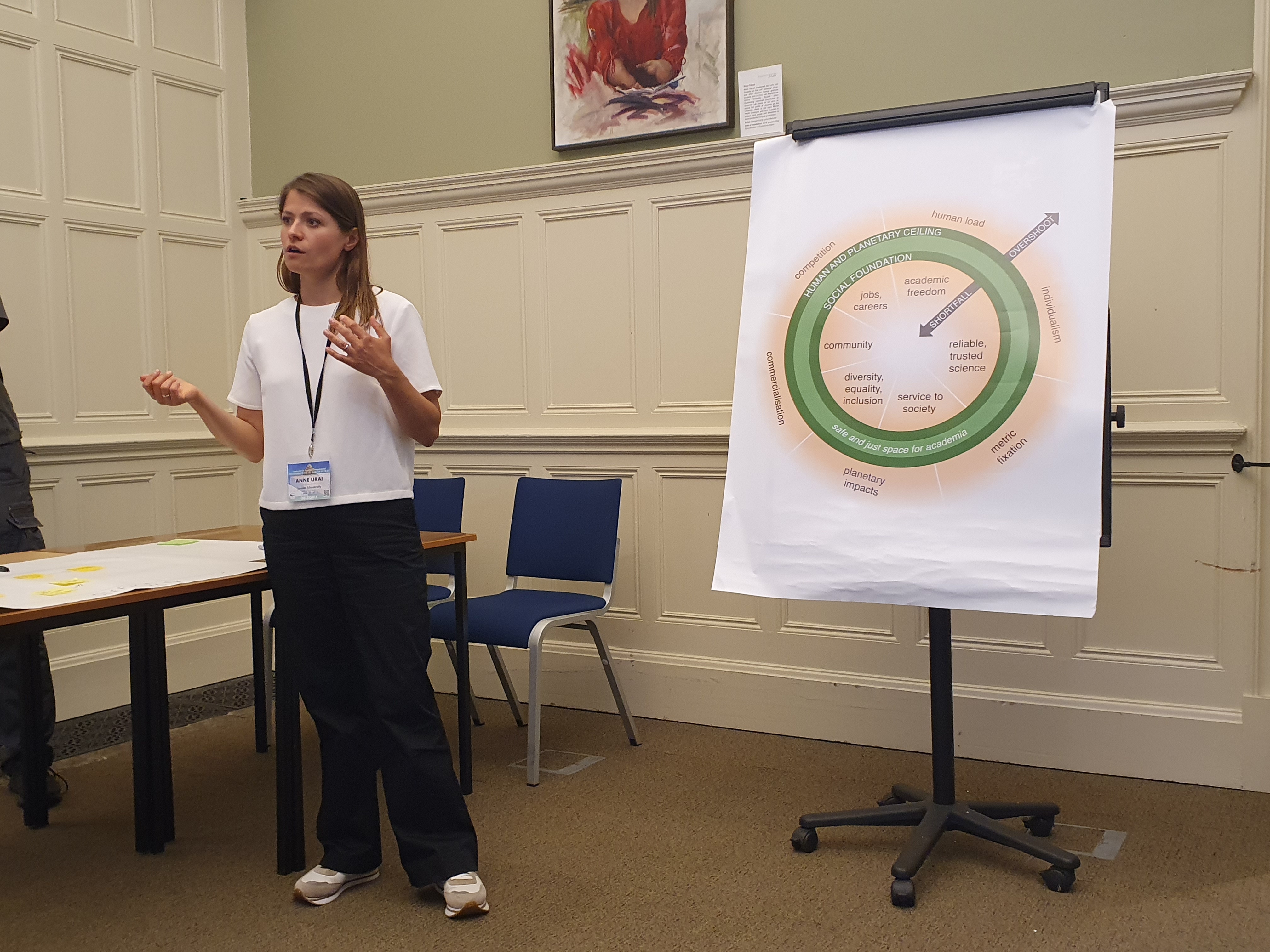
So what does this have to do with academia? There is a rich history of academics as activists, going back to social movements such as woman’s suffrage and civil rights movements, to more recent calls for open science. In Clare and Anne’s recent review article on academics’ response to the climate crisis, they argue that climate issues cannot be separated from other pervasive issues within academia – for example, commercialism, competition and individualism. Applying Raworth’s doughnut model can reveal how these interacting pressures have stood in the way of climate action so far. One implication of this is to move away from considering individual action, and instead to think about how we can revise our whole model of academia to allow for the climate action needed.
Read the article, or watch a short talk about it, here.
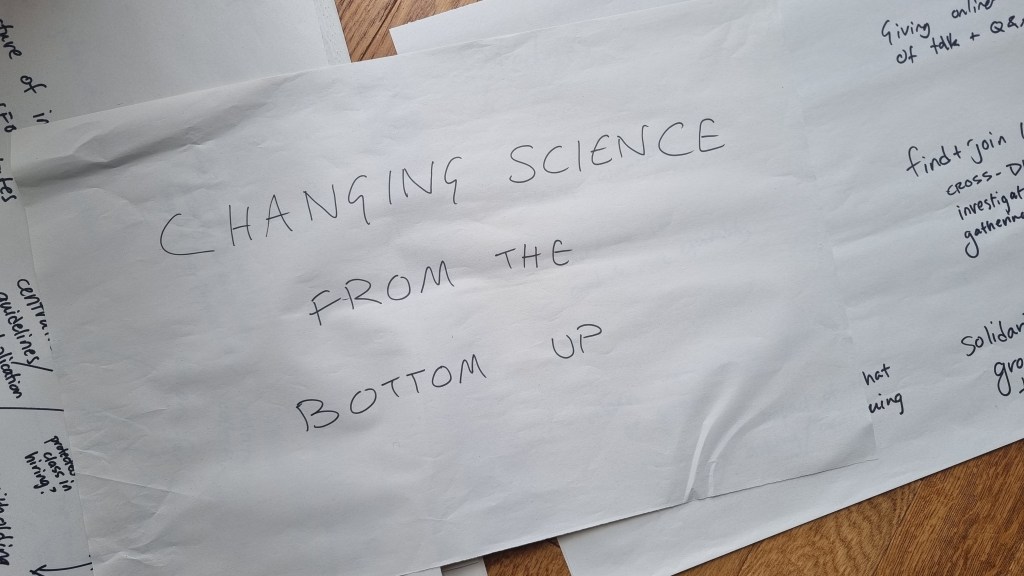
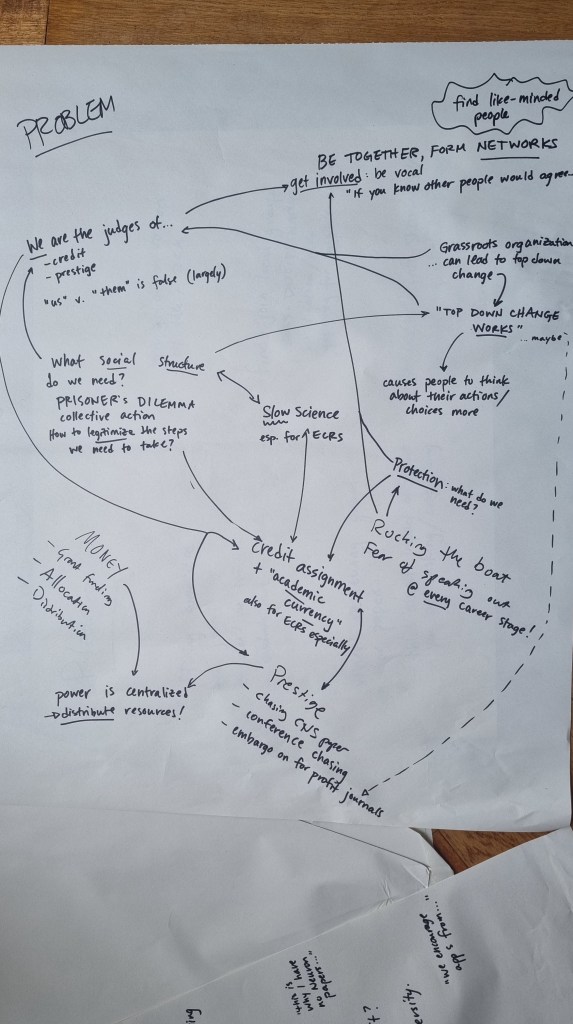
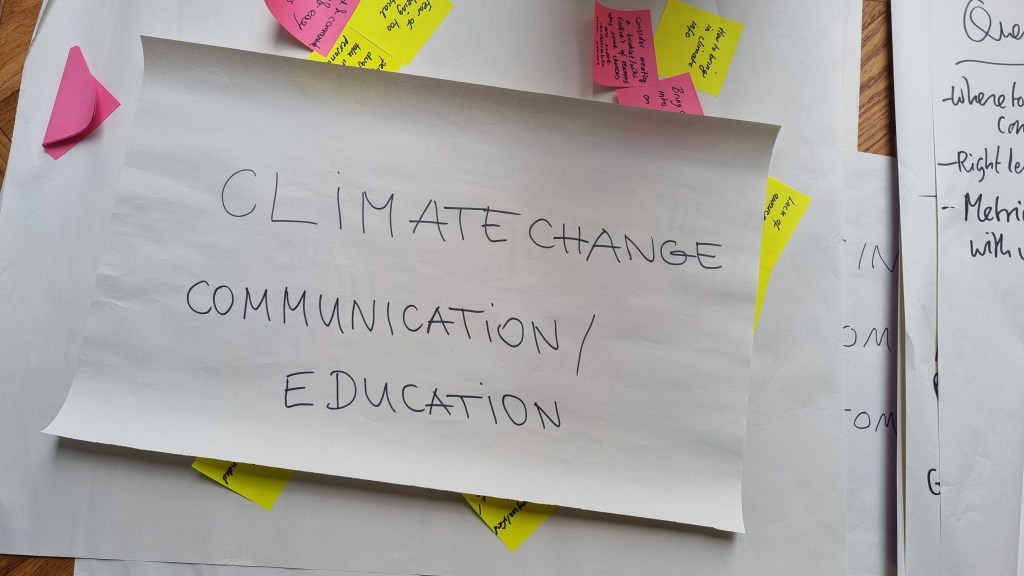
So, what can academics actually do? For the second part of the workshop, we split into groups to discuss areas of climate action relevant for academics.




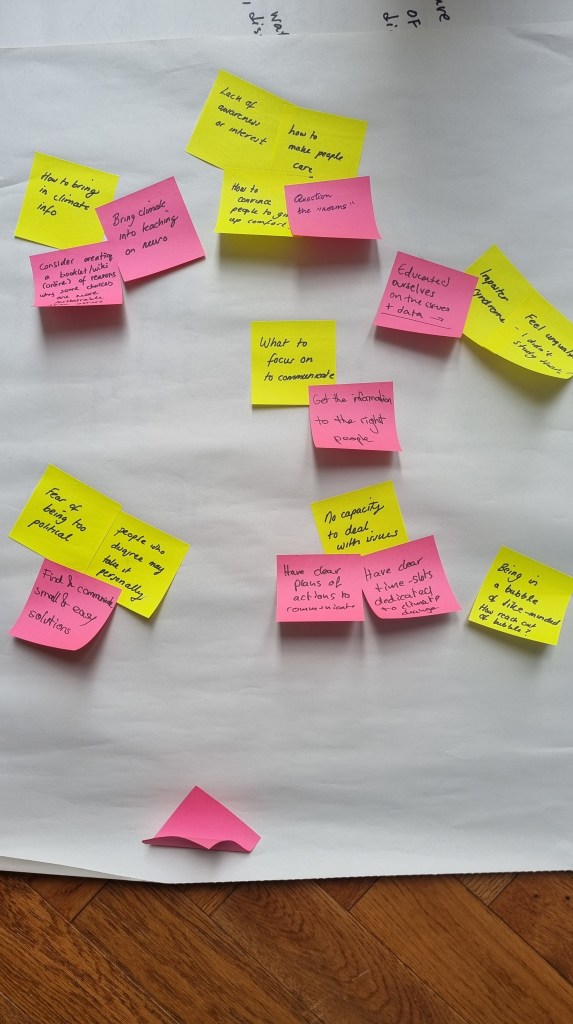


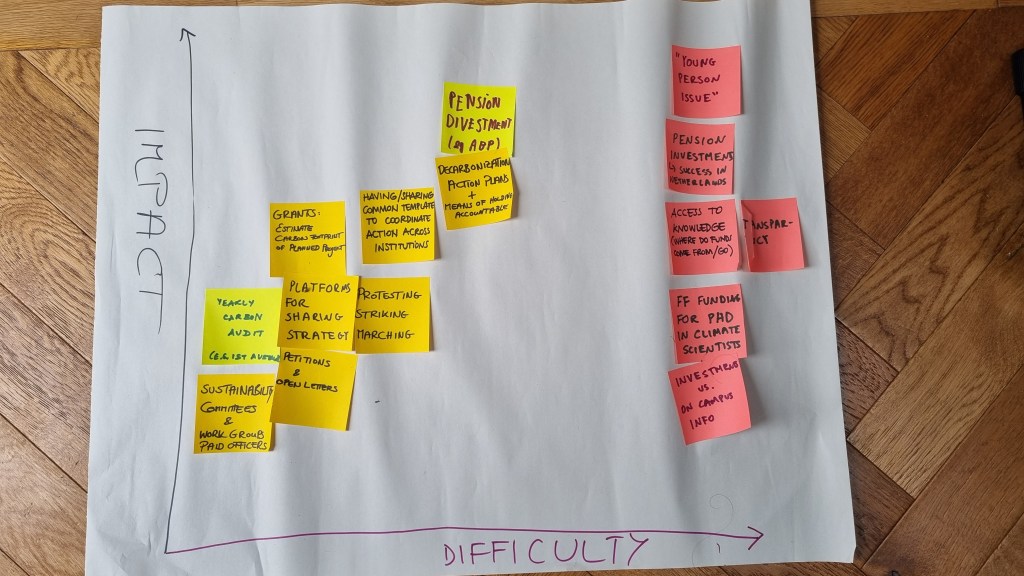


Divestment and University Action
Moderated by Eleanor Holton and Anne Urai
Divestment (i.e. committing to ending financial investments in fossil fuels) has been an area where academics and students within Universities have already achieved impressive change. For example, People and Planet’s campaign ‘Fossil Free’ have already helped 101 Universities in the UK pledge to divest from fossil fuels, covering an endowment wealth of over £17.6bn.
In addition, many academics have been involved in shaping and campaigning for the University to have sustainable carbon (and biodiversity) targets.
Action points:
- Has your University pledged to divest? If not, is there an active fossil free University campaign that could benefit from your support? For instance in the Netherlands, academics successfully campaigned for pension funds to be divested from fossil fuels. In the UK, there have been various successful student campaigns for divestment led by Fossil Free.
- Does your University has a net-zero target, a sustainability plan, and a proper sustainability department/team to carry out the plan? (e.g. as an example, see Oxford’s net zero strategy, which describes how they are going to achieve net zero by 2035)
- Does your university collaborate with the fossil industry? Include sustainability as a consideration for choosing research partnerships, and evaluating projects’ ethical standards. See https://www.fossilfreeresearch.org/
- Can your lab, institute or department make some (public) climate commitments? (e.g. to lab funds for trains/public transports rather than flights)? Can you calculate approximate environmental impact of lab activities alongside financial costs (e.g. here for MRI)?
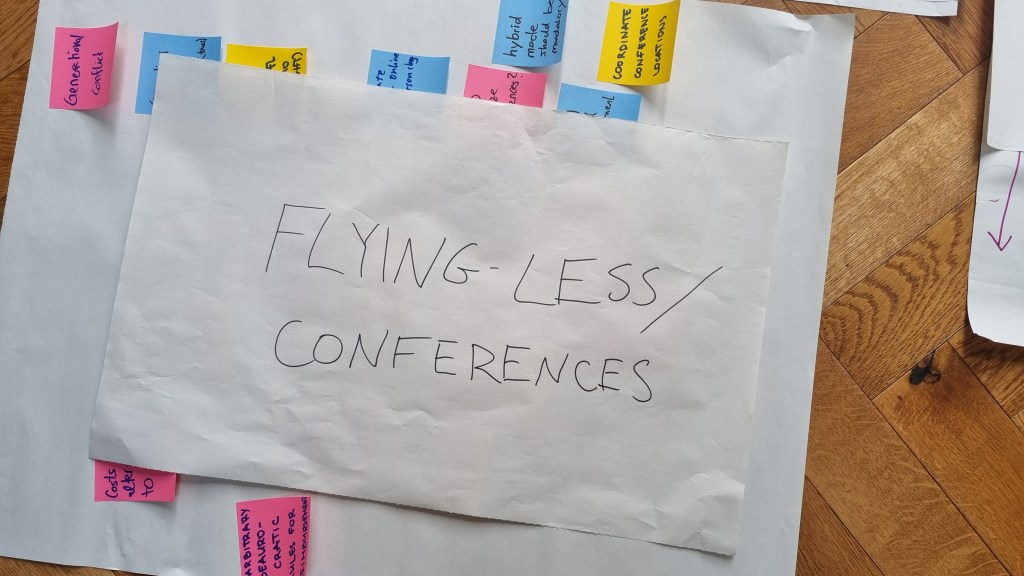
Flying Less
Moderated by Tsvetomira Dumbalska
Flying makes up a large fraction of total emissions in universities and research institutions.
Action points
- Require that funding applications and funding bodies include the costs of ‘greener’ forms of transport (e.g. extra costs associated with train travel)
- Experimenting with hybrid conferences e.g. separate European/American conferences hubs to reduce flying as described in this blog post, or more global conference styles such as Neuromatch
- Public commitments to not flying (e.g. here, here, here)
Activism outside academia
Moderators: Wei Ji Ma and Ionatan Kuperwajs
Within academia (I know, this was not our mandate)
- Education
- Teach a course about the climate crisis, potentially with an emphasis on behavioral aspects.
- Easy to do: share materials globally!! Clare has been teaching a course, Philipp Hennig Tuebingen) as well; Madalina Vlasceanu and Weiji Ma will teach a climate course next year.
- In data science or similar courses, use climate-related examples and promote climate-related projects.
- Offer for-credit opportunities for climate-related outreach (e.g. independent study).
- If you are a trainee, convince an instructor to do the things above.
- Teach a course about the climate crisis, potentially with an emphasis on behavioral aspects.
- Departments and programs
- Ask for a societal impact plan when hiring.
- Better align metrics with values: Count science-based outreach, activism, and advocacy for tenure and promotion
- Encourage and offer opportunities for outreach, activism, and advocacy
- Publish a ranking of universities by societal impact
- If this is too much work, then easier to do: website with a listing of outreach, activism, and advocacy by university. This will help trainees choose places.
- Hold a workshop like this CCN workshop
- Draw new students in when they arrive
- PIs in the US: think about climate-related action for the “Broader Impacts” section of grant applications for the National Science Foundation
Outside academia
- Start a ScAAN-like group (www.scaan.net): partner with environmental non-profit organizations (or journalists) to provide pro-bono science for their legal and political fights. This could be knowledge briefs (fact sheets), presentations, data visualizations, and simple data analysis.
- Easy to start with the skills that you have
- Time commitment is flexible so can be combined with research
- Talk to Weiji (weijima@nyu.edu) or Ionatan (ikuperwajs@nyu.edu) on how to get started
- Going to protests (but we considered this low marginal impact)
- Lobby policy-makers and electives representatives to start climate education in schools at a young age
- Join Scientists for a Future (or one of their sister groups)
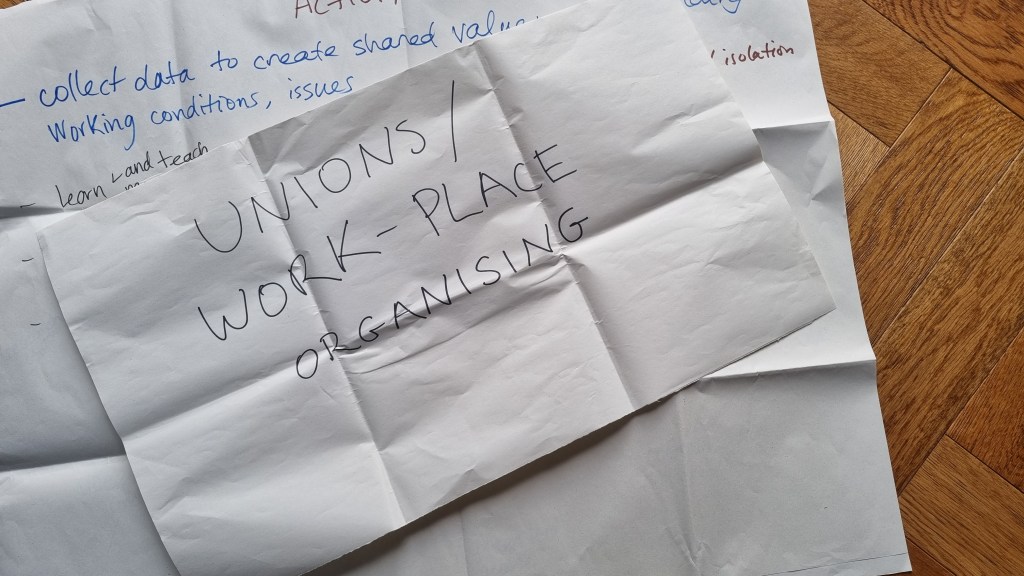
Organizing in the Workplace/Trade Unionism
Moderator: Jess Thompson
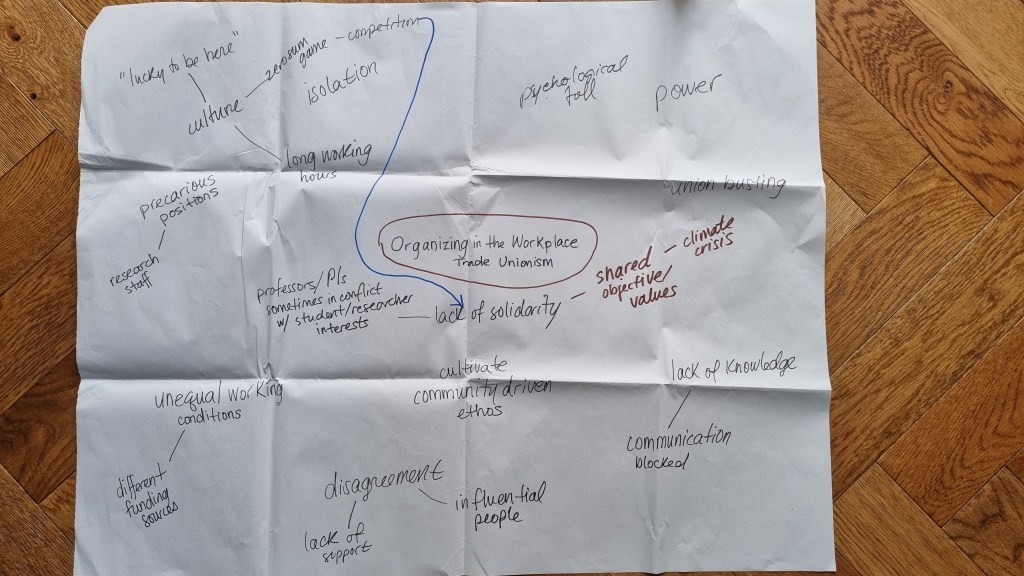
- Various aspects of academic culture/institutions that get in the way of uniting as workers
- Short-term, precarious contracts with high-turnover.
- Lack of solidarity between junior and senior staff. PIs often have a conflict of interest regarding the working conditions of the students/researchers
- Competitiveness
- Long working hours
- A sense that we are lucky to be here and should be grateful for what we have
- Different sources of funding/colleges have different standards – hard to build solidarity when the workforce is fractured in this way
- Lack of knowledge about unions, unions not visible or active. Communication sometimes blocked.
- Isolation
- Academics don’t always see themselves as workers.
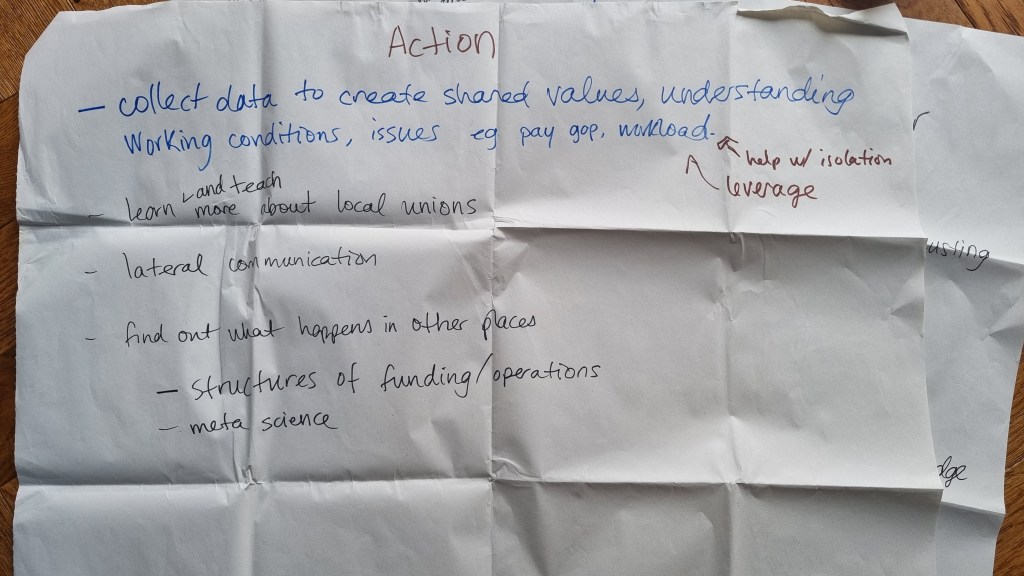
- General strategies to move forward
- Focus on shared values/objectives to build unity and solidarity. Seeing addressing various workplace issues as part of our response to the climate crisis creates a shared value.
- Build on and cultivate the community-driven ethos that already exists in many academic research communities, especially the open-science community
- Collect data on the experiences/situations of academic workers to understand working conditions, the extent of workplace issues like underpay, overwork, paygaps, mental health, lack of parental support. This can help people to feel that they are not alone (becoming active in a union also helps with this) and provides leverage with which to build solidarity and advocate for change.
- Lateral communication. Learn from others in different places. What forms of research funding exist. Are there some funding strategies/contracts/organizational structures that are more equitable and/or better for the climate than others? How do these organizational differences affect research impact/output? Meta-science.
- Concrete actions
- Discussants pledged to learn more about the unions in their local community and to then pass on their new knowledge to others around them.
Take-home
There is appetite for change, energy take action, and lots of ideas to get started. We’ll follow up with the participants, and we look forward to hearing how these actions play out!
All workshop materials are available here, and we encourage everyone to host a workshop at their own institution/conference/community. Let us know if you do so, and give us feedback!
Eager to get involved, but can’t find a local group?
Join the Climate action NeuroPsych community!
 CoCoSys lab